A five-foot tree sitting beside a nursery pot can make ten feet of open yard look extremely generous. Give it a few years, and that comfortable gap can start looking suspiciously narrow.
Young trees make spacing difficult because everything around them looks oversized. Houses are enormous. Driveways are wide. Roots are barely visible. A tree that eventually reaches 40 or 60 feet tall may currently fit into the back of an SUV.
Planting distance depends on mature height, canopy width, root behavior, soil conditions, foundations, pavement, underground pipes, and nearby utilities.
We would rather work through those details before planting than discover ten years later that a trunk, root, or branch has picked its own preferred location.
How Far Should a Tree Be From a House?
Start with mature size, not current size. Useful starting distances look like this:
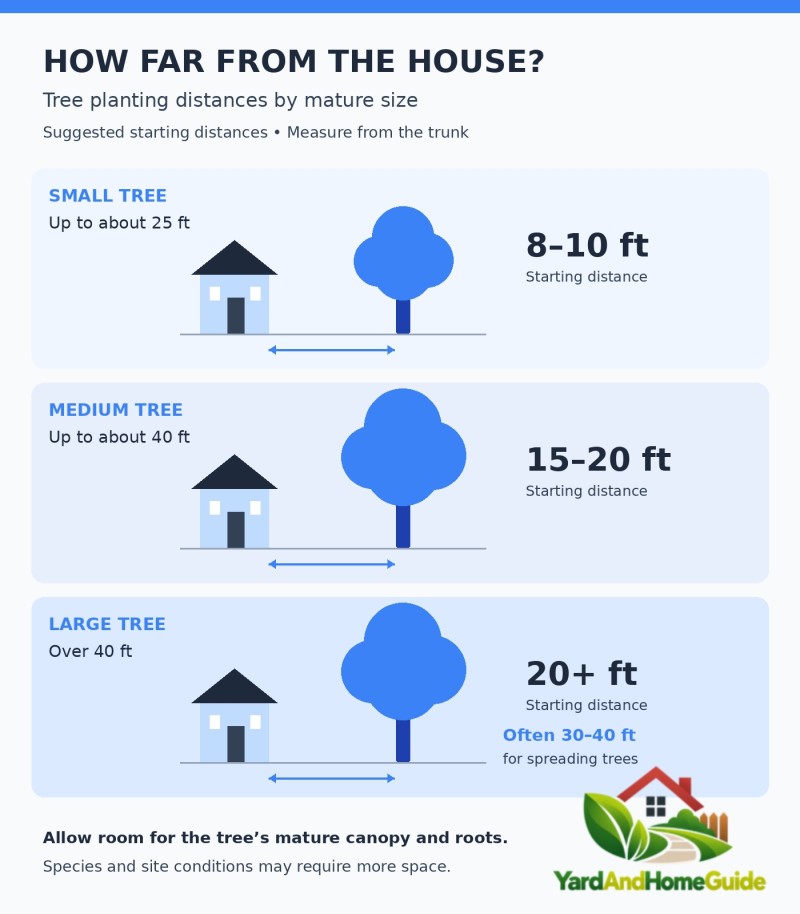
Those numbers give you a sensible first check, but canopy width matters almost as much as height.
A tree that matures at only 25 feet tall may still spread 20 feet across.
Planting its trunk eight feet beside a wall leaves very little room once half that canopy begins reaching toward siding, gutters, and roof shingles.
For smaller trees, using roughly half the mature canopy width plus some extra clearance gives a practical starting point.
A tree expected to spread 20 feet across would therefore need roughly 10 feet just to accommodate half its mature crown, with added space making maintenance easier.
More conservative advice may be sensible around buildings. Trees capable of exceeding about 20 feet can justify roughly 33 feet of separation in situations where roots, soil movement, or foundation conditions create greater concern.
Different recommendations are not necessarily contradictory.
Soil type, species, foundation construction, drainage, root behavior, and local growing conditions can change how much room makes sense.
A Japanese maple beside a modern foundation in stable soil creates a very different situation than a thirsty willow beside an older building sitting on shrinkable clay.
When to Leave More Space
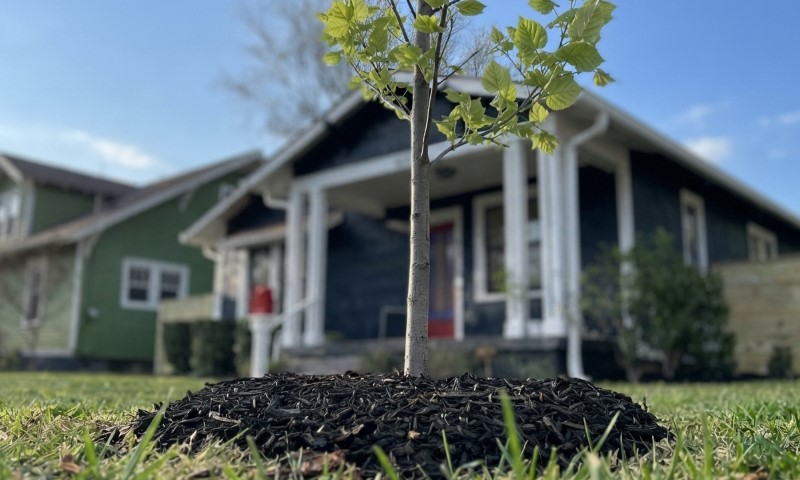
Extra clearance is sensible when you are dealing with:
- large or wide-spreading trees
- vigorous or moisture-seeking root systems
- shrinkable clay soil
- shallow or vulnerable foundations
Clay deserves particular attention.
Some clay soils shrink as they lose moisture. Clay and compacted ground can also keep roots surprisingly close to the surface. In those conditions, 90% to 95% of tree roots may occupy the top 12 inches of soil, with roughly half sitting within the top four inches.
Large trees with high water demand can pull substantial moisture out of nearby soil during dry periods, increasing shrinkage around susceptible foundations.
Roots do not need to physically punch through a foundation to contribute to trouble. Soil movement itself can be the problem.
We would be more conservative with spacing when a large tree, thirsty roots, shrinkable clay, and an older foundation all appear in the same yard.
None of those factors becomes less troublesome simply because the sapling currently looks polite.
How Close Can You Plant a Tree to a Driveway?
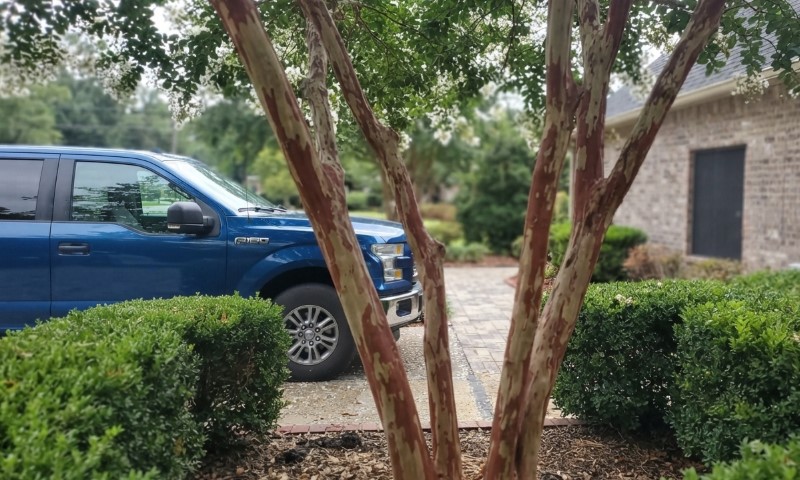
Roots growing near pavement may lift sections of asphalt, concrete, or pavers. Damage usually develops gradually as roots thicken and soil shifts.
If roots have already started pushing up patio pavers, removing the tree isn’t necessarily the answer. In many cases, you can fix uneven patio pavers without damaging the tree by adjusting the surface around the roots rather than cutting through them.
Early symptoms can be surprisingly modest. One corner of a paver rises slightly. A seam develops a small ridge. A mower wheel starts catching the same spot every Saturday.
No single driveway setback works for every tree. Mature size and root habit matter more than choosing one universal number.
Keeping them about 10 to 15 feet away from pavement is a sensible starting point, particularly where soil is compacted or drains poorly. A narrow strip beside a driveway may look like available planting space, but a vigorous tree may have other plans for it.
We would check nursery information for descriptions such as vigorous roots, shallow roots, surface roots, suckering growth, or moisture-seeking roots. Those phrases tell you considerably more than current trunk diameter.
Weeping willow offers an unusually clear example. About 50 feet of separation is recommended between a weeping willow and driveways, buildings, or septic systems.
That sounds generous until you see a mature willow.
Willows grow quickly, spread widely, and develop extensive roots that actively seek moisture. Putting one ten feet beside a driveway is less a spacing decision and more an invitation to future pavement negotiations.
Smaller ornamental trees generally make better choices beside driveways, especially in narrow planting strips.
How Close Can You Plant a Tree to a Sewer Line?
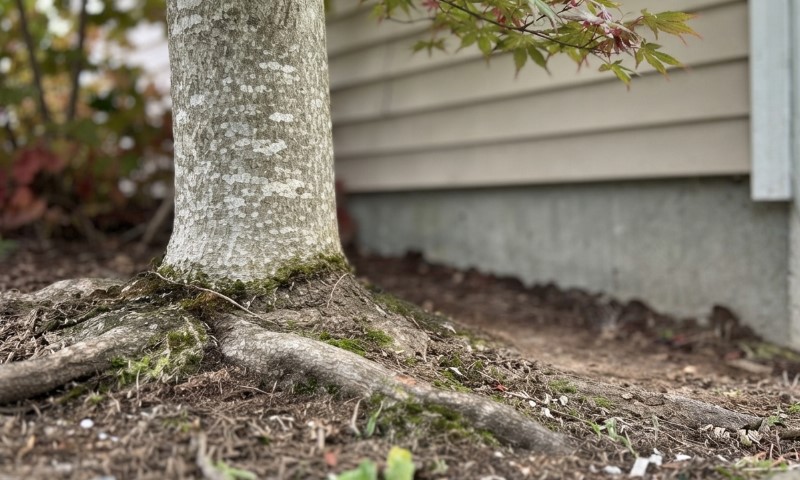
Sewer lines are harder to reduce to one number.
No universal setback works for every tree and every pipe because risk depends on several factors:
- tree species
- mature tree size
- root vigor
- location of the sewer lateral
- pipe age
- pipe material
- existing cracks or leaking joints
A healthy modern pipe is less attractive to roots than an old pipe leaking moisture through damaged joints.
Settling and wear can create cracks in sewer lines, giving roots an entry point that gradually becomes more troublesome as those roots grow. In other words, an old damaged line and a thirsty tree make a much less cooperative pair than either one alone.
Roots generally do not smash straight through sound sewer pipe simply because one happens to be nearby. Existing openings are much more important. A leaking joint, crack, or failed connection can release moisture, and roots are very good at locating dependable water.
Once roots reach an opening, growth inside the pipe can worsen blockage and damage.
Moisture-seeking species deserve considerably more room. Septic drain fields justify an even larger safety margin.
One practical rule is to estimate mature root spread and add another 10 feet. A tree expected to spread roots about 25 feet would therefore sit at least 35 feet away. Giving up a little planting space now is considerably easier than opening a drain field later.
Willows are an obvious example, along with other large trees known for aggressive water-seeking roots.
Locating underground utilities before planting is one of those jobs that feels unnecessarily cautious until you discover that your preferred planting hole sits directly over the sewer lateral.
Finding that pipe before planting generally requires less digging than finding it after a mature tree has claimed the same spot.
How to Work Out the Right Planting Distance
| Check | What to Look For | Why It Matters |
|---|---|---|
| Mature size | Height and canopy spread | Shows how much space the tree will need. |
| Root habit | Surface, vigorous, suckering, moisture-seeking | Helps avoid damage near pavement, pipes, and foundations. |
| Nearby obstacles | House, driveway, sewer, utilities, fences | Identifies areas the tree may conflict with later. |
| Extra room | Clay soil, old pipes, large trees, weak foundations | More space lowers the risk of future problems. |
A short inspection usually tells you more than guessing at a setback.
1. Check Mature Height and Width
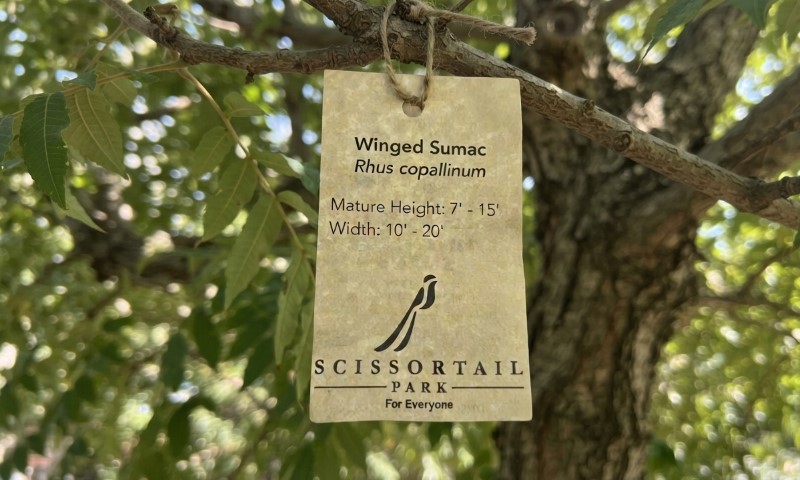
Ignore nursery size.
Look up expected mature height and mature canopy spread for the exact cultivar whenever possible. Two cultivars of the same species can grow to very different sizes.
A tree advertised as compact may fit beside a house nicely. Its larger relative may eventually occupy half the front yard.
2. Check Root Habit
Look for descriptions such as:
- Surface-rooting
- Vigorous
- Suckering
- Moisture-seeking
- Shallow-rooted
Root behavior matters especially near driveways, sidewalks, sewer lines, septic systems, and foundations.
Roots also tend to grow heavily where soil conditions are favorable. Moist, loose soil can encourage stronger growth than compacted dry ground.
3. Map Nearby Obstacles
Mark anything that could matter later:
- house walls and foundations
- driveway edges
- sidewalks
- sewer lines
- septic tanks and drain fields
- underground utility lines
- overhead cables
- fences
Measuring before digging is rarely the enjoyable part of planting a tree, but moving a tape measure is considerably easier than moving a 15-year-old maple.
4. Add Room When Conditions Are Less Forgiving
Large size, aggressive roots, clay soil, older pipes, vulnerable foundations, and narrow spaces all justify greater separation.
Minimum spacing should not automatically become target spacing.
If a tree fits at 15 feet but you comfortably have 25 feet available, giving it extra room usually creates fewer conflicts later.
Small Trees Are Usually Better for Tight Spaces
Limited planting space does not automatically mean you have to give up on having a tree.
Choosing a naturally smaller tree usually works better than forcing a large tree into a small opening.
For trees that genuinely mature at about 25 feet or less, roughly 8 to 10 feet beside a house can work in many situations. Mature canopy width still needs checking, along with roots and foundation conditions.
Cultivar names matter here.
One variety may mature at 15 feet while another tree carrying the same general species name reaches 30 feet or more. Buying based only on a nursery tag that says “ornamental tree” can leave a lot of unanswered questions.
Pruning can control some growth, and techniques such as pollarding can restrict larger trees. Continuing maintenance is part of that decision, though.
A planting plan that only works if somebody prunes the tree forever is already asking quite a lot of future homeowners.
We usually prefer choosing a tree whose natural size fits the available space.