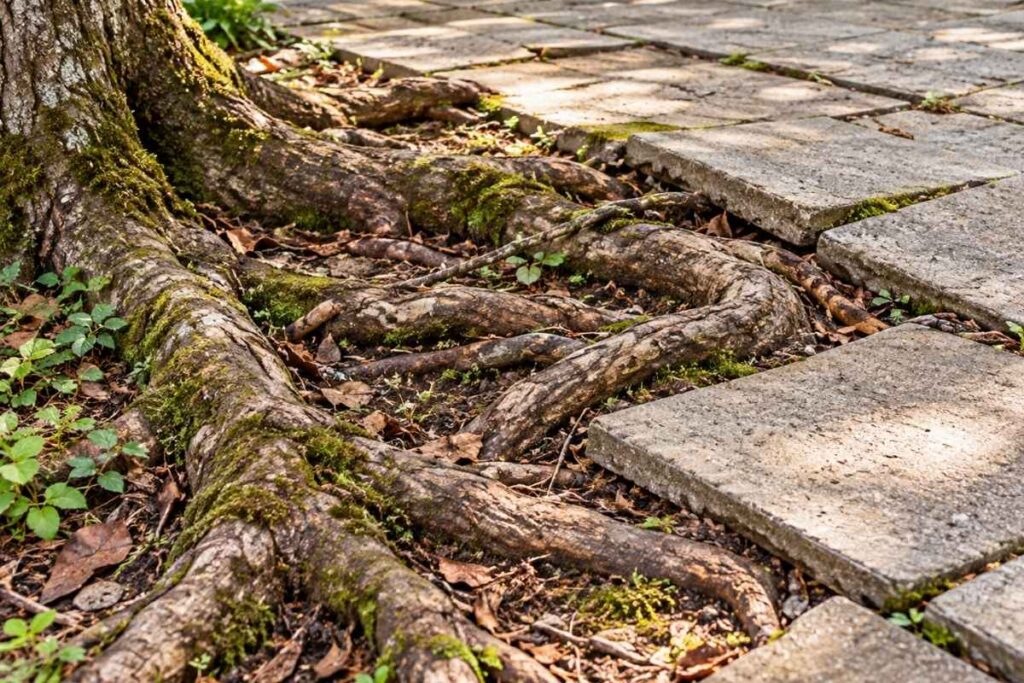
A patio can look perfectly normal for years, then one paver starts sitting higher than its neighbors. Soon a chair wobbles, rainwater collects along one edge, or somebody catches a shoe on a corner that used to be flat. Tree roots are an obvious suspect, and quite often they are involved.
Most tree roots, along with almost all fine absorbing roots, sit within roughly the top 30 cm, or 12 inches, of soil. That puts them directly in the same shallow zone occupied by patio bases.
Hard surfaces can also compact soil farther down, which can encourage roots to travel close to the paving instead of heading lower.
Yes, a patio can often be repaired without seriously harming the tree.
First, Make Sure the Tree Root Is Actually the Problem
A raised line or gentle hump across several pavers often points toward an active root. Widening joints, slight tilting, or a new low spot where water collects can also appear as a root thickens beneath the base.
Sunken paving can tell a different story. An old root may have died and decayed, leaving an empty pocket under the patio. Pavers then settle into that void instead of being pushed upward.
Other causes can look surprisingly similar. Poorly compacted base material, drainage problems, ordinary soil settlement, and frost heave can all move paving.
Lift the affected pavers before deciding what caused the damage. Five minutes of inspection can save a lot of unnecessary root cutting.
A tree may be guilty, but patios have enough ways to misbehave without assistance.
Why You Should Not Automatically Cut the Root
Important roots do more than collect water. Larger roots help anchor the tree, while smaller roots help with water and nutrient uptake.
Root systems also cover considerably more ground than the branches suggest.
Mature tree roots can spread two to five times the width of the canopy, so finding an important root several feet outside the drip line is not particularly unusual. A patio can therefore run into the tree long before it looks especially close to the trunk.
Cutting a substantial root can stress a tree, reduce stability, and create an opening for decay. Cutting can also solve very little if nearby roots continue thickening under the same patio area.
Risk depends on root diameter, distance to the trunk, tree condition, and species.
Willow, poplar, and silver birch are known for shallow rooting habits that can create more surface conflicts. Oak generally develops a lower rooting pattern, although soil and site conditions still matter.
A small root near the patio edge is not the same problem as a thick structural root close to the trunk. Treating both as equal is how a simple paving repair can turn into a tree problem.
Adjust the Patio Around the Root
Making the patio accommodate the root is often the least disruptive repair.
Lift and Reset the Affected Pavers
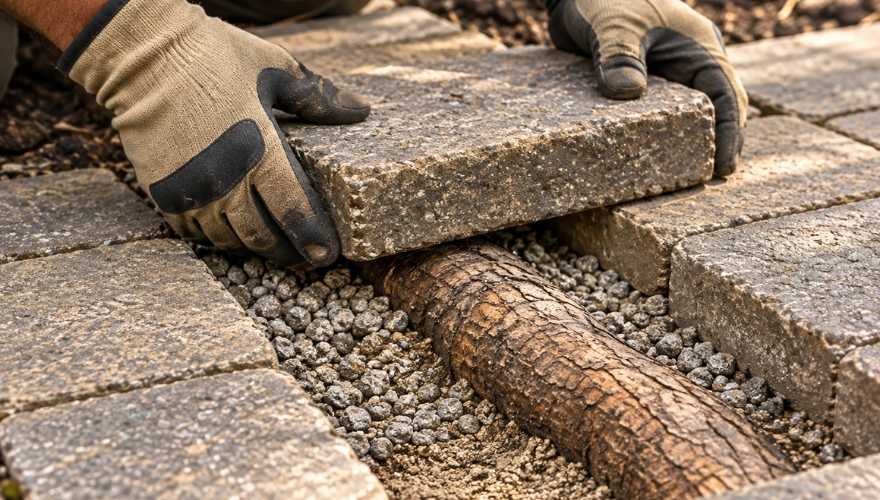
Individual pavers have one useful advantage over rigid concrete. Each unit can be lifted, adjusted, and reset without demolishing a large slab.
Carefully expose the area beneath the lifted pavers. If a live root is creating the hump, raising or regrading a wider section can create a smoother transition without cutting that root.
Trying to flatten only one paver can create another sharp edge beside it. Spreading the adjustment across several pavers usually produces a better walking surface.
Paver base panels can help distribute pressure across a wider area.
They cannot stop root heave, but they may reduce the chance of one isolated paver becoming a pronounced trip edge.
Give the Tree More Room
Sometimes the best paving repair involves using less paving.
Removing a small area around the trunk or an active surface root can reduce future conflict. Mulch, gravel, or a planted area can replace pavers where a hard surface is no longer practical.
More open soil also gives roots space to expand without immediately pushing against a rigid patio base.
Research has identified less than about 6.5 to 10 feet between a tree and pavement, along with tree ages above roughly 15 to 20 years, among the conditions associated with more hardscape conflicts.
A patio installed beside a young tree can therefore look perfectly sensible for quite a few years before growth catches up with the design.
A perfectly healthy tree has no particular interest in keeping your patio joints straight. Unfortunately, nobody explained the layout plan to it.
When Root Pruning Can Make Sense
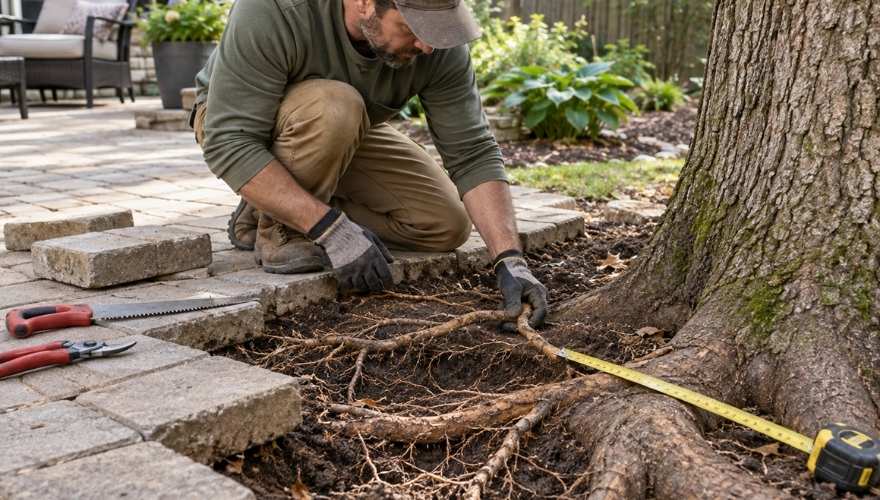
Selective root pruning can be appropriate when a tree can safely tolerate losing a particular root.
Small roots located well outside the trunk area may sometimes be cut as part of a repair. Large structural roots and several substantial roots should not be treated the same way.
Diameter alone does not tell the whole story. Distance gives us another useful warning sign. UF/IFAS recommends avoiding root pruning inside a radius equal to about five times the trunk diameter.
On a tree with a 20-inch trunk, that works out to roughly 8 feet 4 inches. Suddenly, a root that looked comfortably far away may not be quite so expendable.
An arborist should assess any root that looks important to stability before it is cut. Sacrificing a major root just to regain a perfectly flat patio can create a much more expensive problem later.
Root pruning works best as a controlled decision, not as the automatic response to every raised paver.
Watch the video on the Tree Man YouTube channel, where they explain in detail how to cut tree roots without killing the tree.
Can a Root Barrier Keep the Problem Coming Back?
A root barrier can redirect future root growth and may make sense during a patio repair, especially where repeat heaving has already happened.
Some installations use barriers about 24 to 36 inches into the soil. Exact depth depends on tree species, soil conditions, barrier material, and the area that needs protection.
Placement matters just as much as depth. A barrier installed too close to a mature tree can interfere with important roots instead of simply redirecting new growth.
Ordinary geotextile should not be treated as a guaranteed root barrier. Fabric can help separate base layers and keep materials organized, but determined roots can still create movement beneath paving. Base preparation and fabric can improve the patio. Neither can convince an established tree to stop growing.
Fix the Base Before Resetting the Pavers
Once the pavers are lifted, inspect the base instead of immediately adding sand and putting everything back.
Look for displaced material, eroded areas, empty pockets, and poorly compacted sections. A root may have lifted the paving, but water movement or loose base material can make the damage worse.
Rebuild the affected base and compact it properly before resetting the pavers. Adjust the grade across enough area to avoid creating another abrupt edge.
If an active root caused the lift, deal with that conflict through regrading, added clearance, selective pruning, or another suitable repair. If a decayed root left a void, fill and compact that void properly.
Simply leveling the top surface can hide the symptom without correcting the cause. In that situation, the same section may begin failing again within a year or two.
Nobody enjoys lifting the same patio twice because the first repair only improved its posture.
When to Call an Arborist
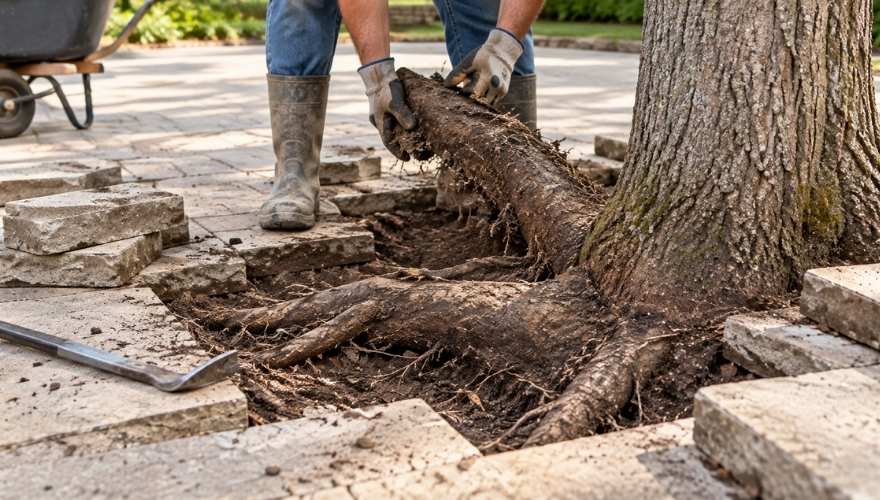
Some patio repairs move past ordinary DIY territory once large roots enter the picture.
Root size can provide a useful stopping point before the saw comes out. UF/IFAS advises that a root larger than about 25% of trunk diameter may not be safely removable without putting the tree at risk.
At that point, we would treat the arborist call as part of the repair rather than an optional extra.
Professional advice is worth getting when:
- A root is large or sits close to the trunk.
- Several substantial roots are involved.
- A tree is leaning, stressed, damaged, or unhealthy.
- Repairing the patio would require major root cutting.
- You need to know which roots matter most for stability.
- Future growth is likely to keep pushing against the same paved area.
An arborist can help identify which roots can tolerate pruning and which ones should be left alone.
Arborist can also help you think ahead when planning future plantings, including where a new tree can be placed without creating similar conflicts with the house, driveway, or sewer line.
That decision matters most near mature trees, where one badly placed cut can create consequences far larger than a crooked patio joint.
Let the Patio Adapt Before Making the Tree Adapt
Start by confirming what is actually moving the pavers.
Preserve important roots when practical. Lift, regrade, reset, or redesign the paving around them before reaching for a saw. Use root pruning or a barrier only when the site and tree make those options sensible.
A few uneven pavers are usually easier to adjust than a mature root system.
Fix the cause under the patio, not only the surface complaining about it.