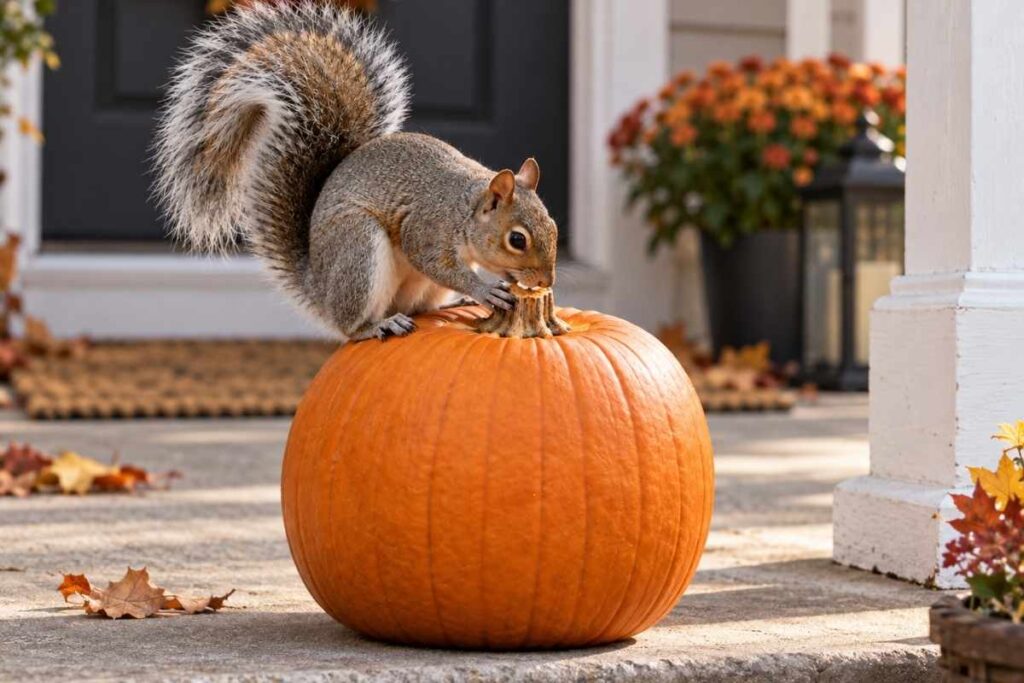
You arranged the pumpkins, stepped back, and decided the porch finally looked ready for fall. By morning, one has tooth marks, another is missing a chunk, and seeds are scattered across the steps.
Squirrels have interpreted your seasonal display differently. Outdoor pumpkins are food, and squirrels can be persistent once they discover an easy meal.
No deterrent guarantees complete protection, so we would start with the simplest fixes and add stronger measures only if needed.
Start by Removing the Easy Food
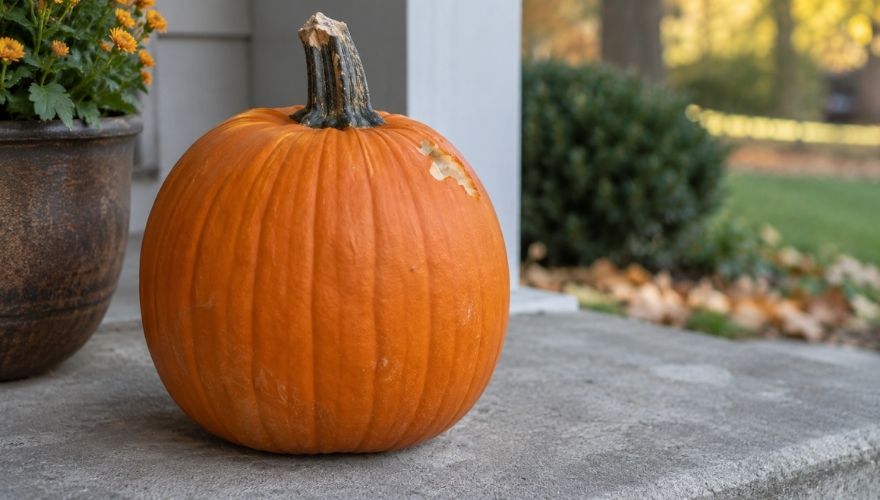
Pick up loose pumpkin pieces, seeds, and pulp around the display. Keep pet food, open trash, spilled birdseed, and other easy food sources away too.
For jack-o’-lanterns, scrape out seeds and stringy pulp thoroughly. Leaving edible material inside gives squirrels another reason to investigate. Check damaged pumpkins while cleaning.
A few shallow tooth marks do not automatically mean a pumpkin needs to go. Carving also starts a fairly short clock. A jack-o’-lantern can begin showing noticeable rot within only a few days, with about a week already being a reasonable lifespan in some conditions.
So softness around a carved opening may not mean the squirrel accomplished all that damage personally.
Sometimes the pumpkin is perfectly capable of falling apart without assistance. Firm fruit with minor surface damage may still work as decoration.
Intact pumpkins are tougher than their carved cousins. Under proper storage conditions, healthy pumpkins can hold good quality for roughly two to three months.
Your front porch is not a temperature-controlled produce room, of course, but it puts a few shallow tooth marks in perspective. Firmness still matters more than assuming any nibble has finished the pumpkin.
Make the Pumpkins Less Appealing
Cleaning removes easy food. Next, make the pumpkin itself less pleasant to chew.
Try a Hot-Pepper Deterrent
View this post on Instagram
Capsaicin, the compound that gives chili peppers their heat, is one of the better-supported taste deterrents for squirrels. Research gives that idea some backing. In one study, capsaicin-treated seed reduced consumption by about 80%.
A pumpkin is obviously not a bird feeder, so that figure should not be treated as a promise, but it helps explain why hot-pepper treatments deserve a place ahead of the more creative porch remedies people suggest online.
Ground cayenne can be applied where appropriate, or you can use a diluted hot-sauce spray. Rain and prolonged sunlight can reduce effectiveness, so outdoor treatments may need to be reapplied.
Use pepper products carefully around pets, children, plants, and porch materials. Capsaicin can irritate eyes, noses, skin, and paws. Homemade mixtures can also stain some surfaces, so test a small hidden area first.
Consider Commercial Repellents
Commercial squirrel repellents are another option. Many use unpleasant tastes, strong odors, or both. Follow label directions carefully and expect results to vary.
One squirrel may leave quickly while another treats the smell as a minor inconvenience. We would spend less time on household remedies such as pet hair or soap. Support for those methods is mixed, and outdoor odors often fade quickly.
Make the Pumpkins Harder to Reach
If taste deterrents are not enough, access becomes the next thing to change. Bringing pumpkins indoors when nobody is around is simple and effective.
A garage, enclosed porch, mudroom, or similar protected area can keep them safe overnight. Carrying pumpkins in and out is not especially elegant, but a squirrel cannot chew a pumpkin sitting behind a closed door.
Woven wire mesh can also protect small displays, especially in garden areas. Porch entrances need more caution. Avoid loose wire, netting, or barriers across steps, handrails, and walking routes.
Protecting a pumpkin is not worth creating a tripping hazard for everyone using the front door. Look at placement too. A pumpkin beside a railing, low wall, planter, or piece of furniture may give squirrels an easy perch.
Moving it a few feet can make access less convenient without adding another product or device. Sometimes changing access works better than repeatedly trying to convince a squirrel that food is no longer food.
For a Persistent Squirrel, Try a Motion-Activated Sprinkler for
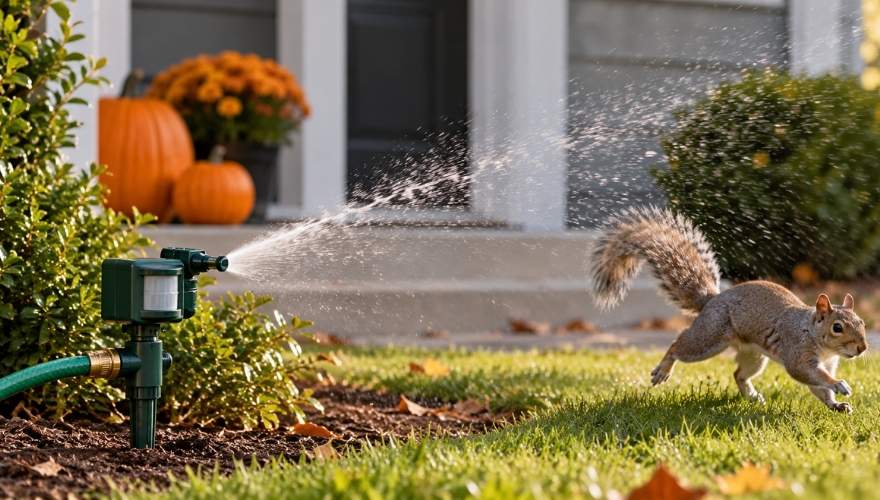
Some squirrels take the hint. Others keep showing up. A motion-activated sprinkler can help with a repeat visitor.
Movement triggers a short burst of water before the animal settles in for another bite. Aim the sensor toward the route squirrels actually use, such as the edge of the yard, a planting bed, or the approach to the porch.
Test the setup after installation. Walk toward the pumpkins and check where the sprinkler activates. Adjust the angle or sensitivity if it sprays too early, too late, or in the wrong direction.
Position may need changing occasionally too. Wildlife can get used to scare tactics that become predictable, and extension guidance recommends moving harassment devices every one to two days when animals keep visiting.
A squirrel that has memorized where the surprise shower starts has already taken some of the surprise out of it. Turn it off before guests, deliveries, or trick-or-treaters arrive.
A deterrent is considerably less impressive if the squirrel stays dry while the delivery driver gets soaked.
Motion sprinklers make the most sense after simpler fixes fail. One missing bite does not require a water-based security system.
Start Simple and Escalate Only If You Need To
Clean up scraps first and inspect the pumpkin. Remove any piece that is soft, leaking, moldy, or collapsing. If the pumpkin is still firm, a capsaicin-based deterrent is a sensible next step.
Persistent visits call for making access harder. Bring pumpkins inside when unattended, move them away from easy jumping points, or use a secure barrier where it will not interfere with people.
Save the motion-activated sprinkler for the squirrel that has clearly put your porch on its regular route. Most cases do not require every tactic at once.
Fix the easiest attraction, see what happens, and add another layer only if the squirrel comes back.