You removed a wasp nest under the deck, cleaned up the mess, and assumed that was the end of it.
A few weeks later, another nest shows up in nearly the same place, as if somebody forgot to tell the wasps their lease had been canceled.
Repeated nesting usually says more about the location than the insects. Decks can offer protected nesting space, easy access to wood fibers, nearby food, water, warmth, and very little disturbance.
Knocking down a nest handles what you can see, but it does not change any of those conditions.
We would treat the repeated location as a clue. If queens keep choosing the same joist, corner, or cavity, something about that exact spot is working very well for them.
Why the Same Spot Under the Deck Keeps Attracting Wasps
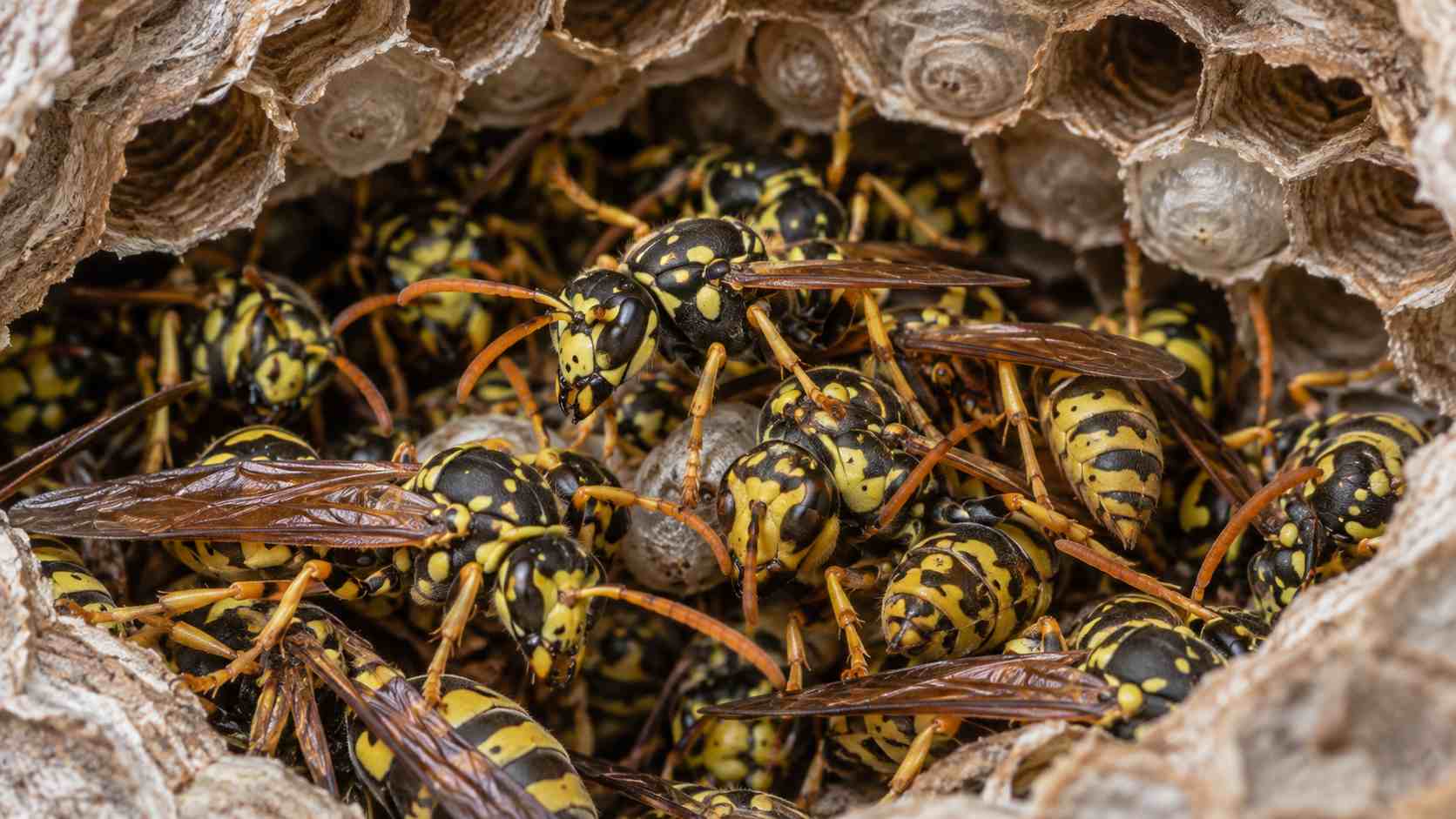
| Factor | Why Wasps Like It | What to Check |
| Better conditions | More shelter and easier access. | Compare the problem area with the rest of the deck. |
| Weather protection | Joists and boards block rain and wind. | Check sheltered beams, railings, and low deck areas. |
| Nesting surfaces | Paper wasps use exposed surfaces, while yellowjackets may use cavities. | Look for combs or repeated entry into gaps. |
| Shade and warmth | Protected areas can stay calmer and more stable. | Check spots with less sun and wind. |
| Low disturbance | Quiet corners let nests grow unnoticed. | Inspect stairs, fascia, trim, and joist corners. |
| Hidden cavities | Part of a colony may stay concealed. | Watch for repeated flights into one opening. |
| Quick return | Fast activity after removal may mean wasps are still nearby. | Check the exact same entry point again. |
Repeated nesting usually means one section of the deck offers better conditions than the areas around it.
Before looking for complicated explanations, compare that spot with the rest of the structure.
Better cover, less disturbance, and easier access can be enough to make one corner consistently more useful to wasps.
It Is Sheltered Against Weather
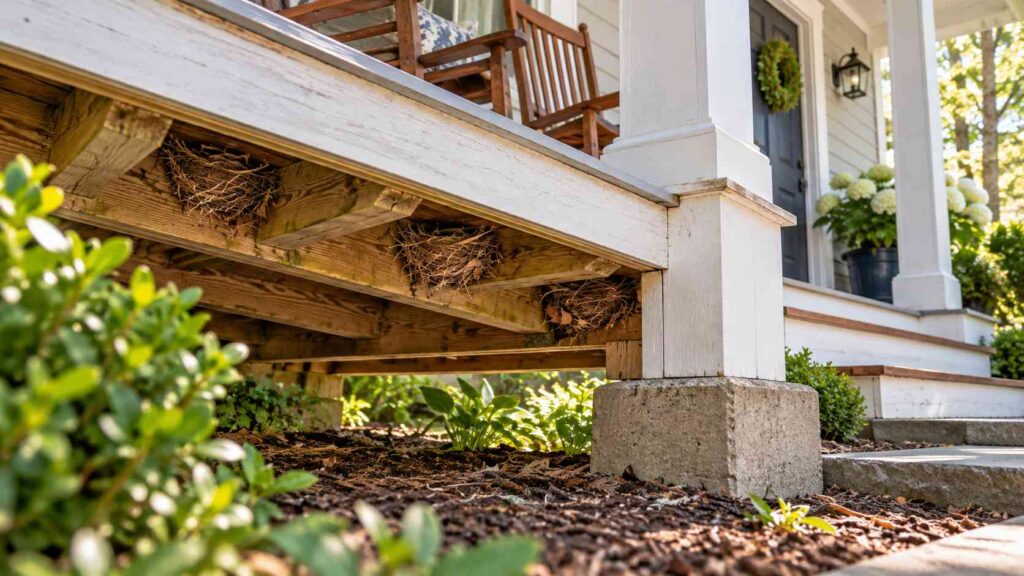
Deck boards, joists, railings, and beams create dry surfaces protected against rain and wind.
Shade can help too, especially when paired with warmth around structural wood. A quiet corner under a deck can offer much better conditions than an exposed branch that gets soaked, shaken, and heated all day.
We would compare the problem area with the rest of the deck. One side may get less wind, less foot traffic, less direct sun, and better overhead cover.
Wasps do not need sentimental attachment to a location when basic shelter already gives them a good reason to come back.
It Does Not Get Disturbed Much
Protected corners under stairs, joist intersections, fascia edges, and hidden sections under trim can go unnoticed for days or weeks. That gives a young nest time to grow before anybody spots it.
Watch where the activity concentrates. If one end of the deck gets repeated traffic while another end stays quiet and shaded, nesting may keep occurring in the quieter section.
Hidden voids deserve extra attention. Some colonies extend into cavities that are not fully visible, so what looks like a brand-new nest can sometimes be activity linked to a colony that was never fully exposed during the first removal.
That possibility is especially important when wasps return very quickly.
Rebuilding after a long gap is one thing. Heavy traffic in the same opening only days later is a good reason to check for hidden activity instead of assuming an entirely new queen has already set up shop.
Weathered Deck Wood Can Supply Nesting Material
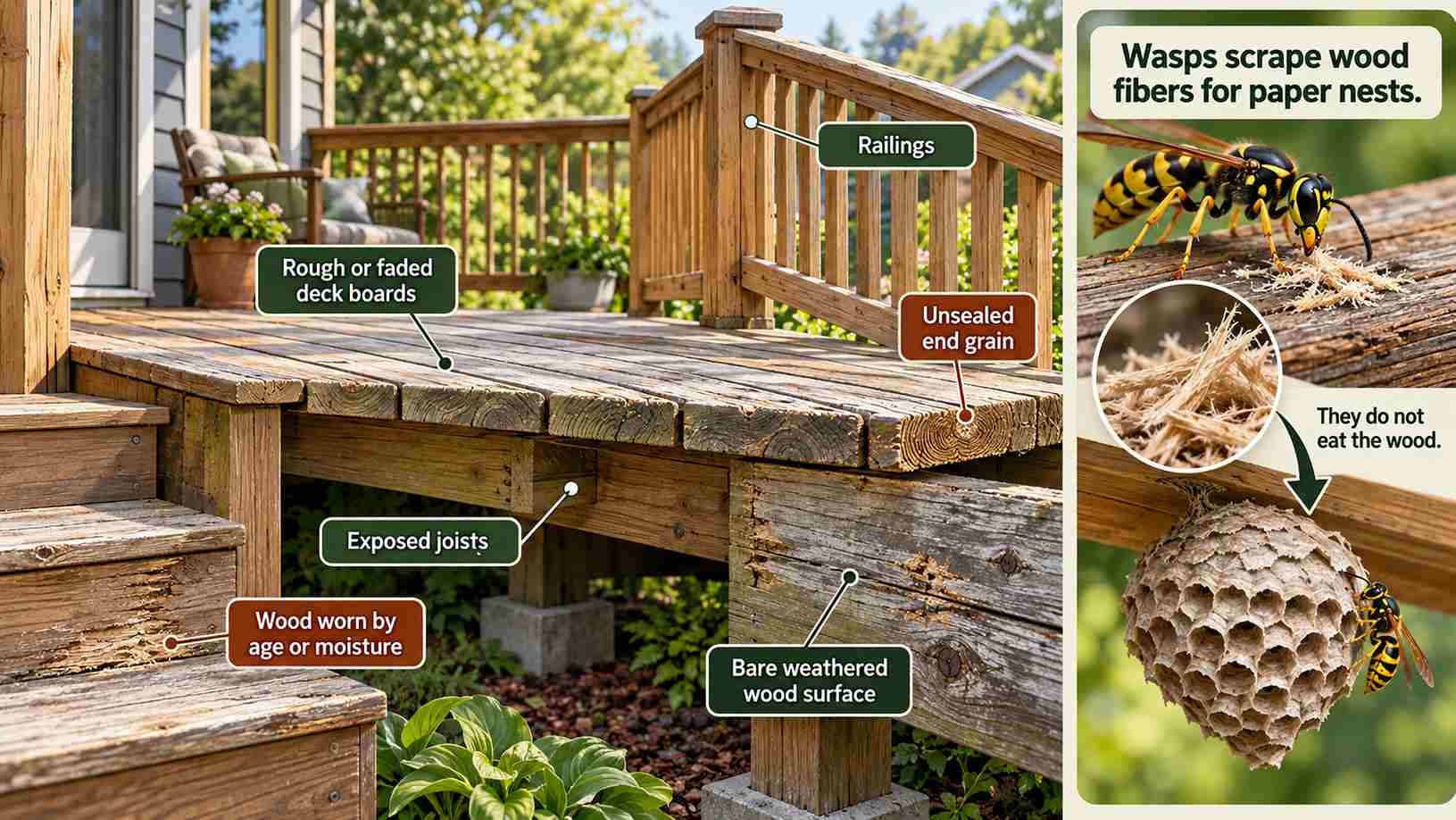
Bare, weathered wood gives paper-making wasps another reason to spend time around a deck.
Wasps scrape wood fibers off exposed surfaces and mix those fibers with saliva to make the pulp used for paper nests. They are not eating their way through the deck. Surface scraping is enough to collect what they need.
Look closely at rough or faded boards, exposed joists, railings, unsealed end grain, and wood worn by age or moisture.
Repeated landings on one bare board may have very little to do with nesting at that exact point. Wasps may simply be gathering construction material.
Sealing or painting suitable exposed wood can reduce easy fiber collection. A maintained surface can also make nest attachment less convenient than rough, unfinished material.
We would not assume that sealing the wood alone will solve the problem. Shelter, food, water, and hidden openings can still matter.
Still, if one rough joist looks as if it has become the neighborhood lumber yard, giving it a proper finish is a sensible part of the fix.
Food and Water Nearby Can Make the Deck Even More Attractive
A deck can provide shelter underneath and dinner a few feet above it.
Wasps eat other insects, but they also investigate protein and sugary foods. Barbecue grease, meat scraps, soda spills, fruit, desserts, open garbage, and dirty recycling can all increase activity around a deck. Insects living around or under the structure can add another food source.
Water can make an already useful site even better. Leaks, irrigation overspray, pet bowls, pools, and persistently damp areas can give wasps another reason to keep working nearby.
Exterior lights can contribute indirectly. Lights attract insects, and predatory wasps may follow the food.
Outdoor lights affect other backyard insects too. Our guide to attracting fireflies explains why reducing unnecessary porch lighting can help make a yard more suitable for them.
Before assuming one joist has some mysterious irresistible quality, check the area around it. Grease beside a grill, an open recycling bin, a dripping hose connection, or a light that collects insects every evening may explain part of the pattern.
Simple cleanup can make a bigger difference than people expect. Wash sticky spills, remove food scraps, rinse recycling, keep trash covered, and deal with easy water sources where practical.
Gaps and Cavities Can Give Wasps Easy Access
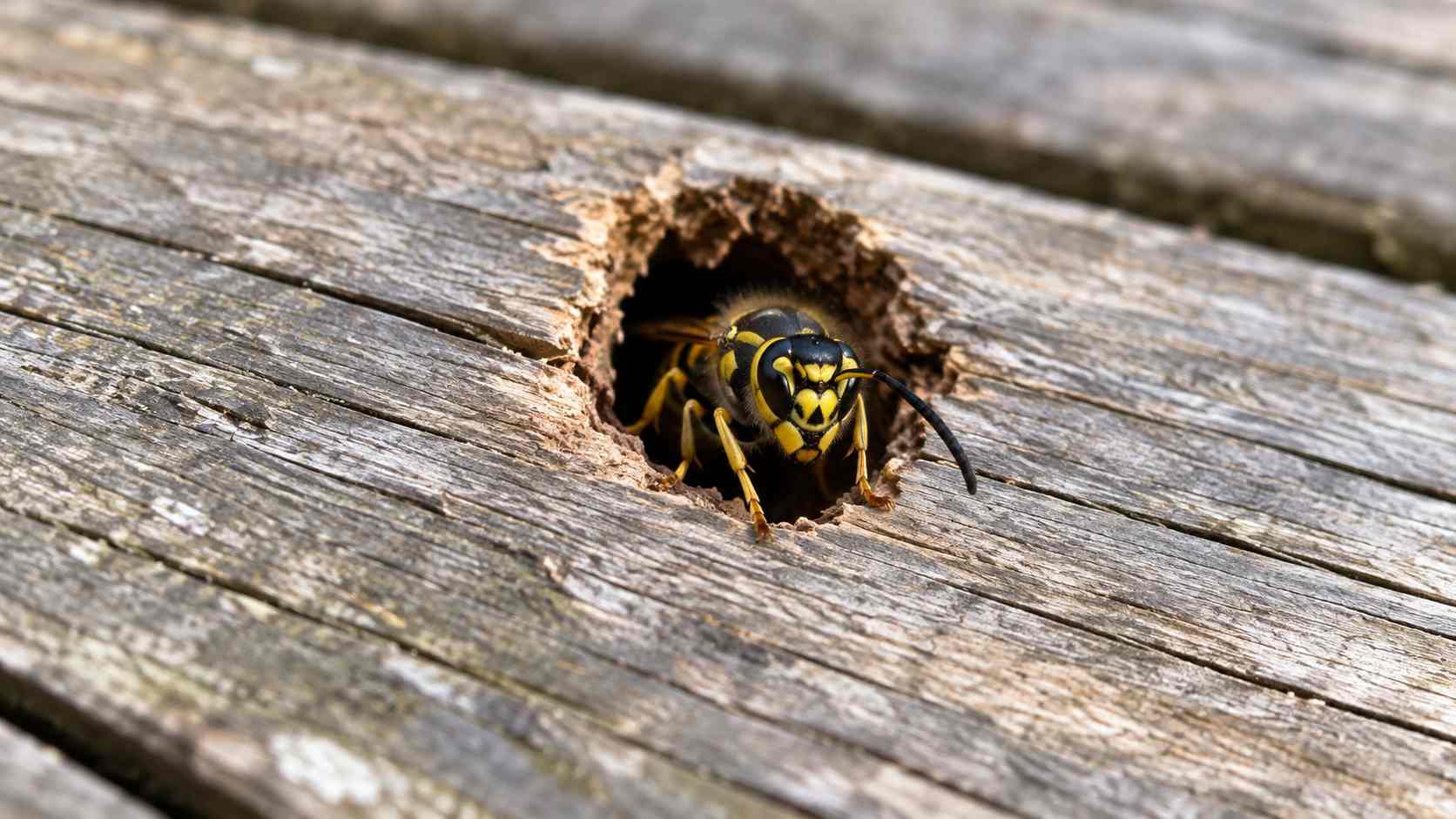
Avoid pulling boards apart as your first move. Watching the traffic pattern at a safe distance usually tells you more.
Repeated flights into one crack, joist cavity, ground hole, or opening are a much stronger nesting clue than one or two wasps passing through. A steady stream into the same spot deserves attention.
Check for split boards, badly worn wood, missing knots, gaps around posts, spaces beside stairs, loose fascia, loose trim, and accessible joist cavities. A worn board or missing knot can create an opening large enough to make the area under a deck much easier to enter.
Unused openings can be repaired after you confirm that no active colony is inside. Sealing a live colony into a cavity can create a different problem, especially if trapped insects start looking for another exit.
We would also resist the urge to attack an opening with a screwdriver just to see what happens. A cavity full of defensive wasps is one of those discoveries that is much easier to appreciate at a distance.
Are They Reusing Last Year’s Nest?
Usually, no. A better explanation is that a new colony has chosen the same useful location.
Paper wasp nests generally last one season. Fresh queens scout for new nesting sites, and a protected deck can keep passing the same inspection year after year.
Fast reappearance after removal can point to something else. Surviving foragers may return and build nearby, part of a colony may still occupy a hidden cavity, or chemical cues left on a used nesting surface may contribute to repeated activity.
Focus on the site rather than the calendar. If the same corner still has cover, rough wood, food, water, and an easy opening, removing one visible nest does not make the location much less useful.
A better question is simple: what about this exact spot still works for them?
How to Make the Area Less Attractive
Start with basic conditions before buying gadgets or trying elaborate deterrents.
| Step | What to Do | Why It Helps |
| Clean up food promptly | Remove barbecue grease, scraps, soda, fruit, and other residues. Brush and wash the deck regularly. | Reduces food sources that attract foraging wasps. |
| Remove easy water sources | Fix leaks, reduce sprinkler overspray, empty standing water, and move pet bowls when practical. | Makes the area less useful as a reliable water source. |
| Repair unused access points | Replace badly worn boards and close gaps, missing-knot openings, and loose trim after confirming no active nest is inside. | Removes easy entry points into sheltered spaces. |
| Maintain exposed wood | Paint or seal suitable surfaces. | Reduces easy fiber scraping and makes rough surfaces less convenient for nesting. |
| Inspect underneath during wasp season | Check joists, stairs, fascia, and hidden corners about once a month. | Helps catch new nesting activity before a colony grows. |
Early inspection matters because a paper wasp nest can stay fairly compact while supporting roughly 15 to 200 wasps.
A small nest under a joist can therefore be more established than its size suggests.
Fake nests, mint plants, and traps often get suggested for wasp problems. We would put those well behind the basic fixes. A decorative decoy has a difficult job if the real nesting site still offers a roof, building material, easy entry, water, and dinner.
When the Nest Is Better Left to a Professional
Professional help makes sense when wasps are entering a hidden joist, wall, or structural cavity, especially when you cannot see how far activity extends.
Large or highly active colonies also deserve caution. Awkward access under a low deck can leave very little room to retreat, and wasps can become much more defensive when their nest is threatened.
Serious sting allergies change the risk calculation as well. In that situation, avoiding close contact matters more than saving money on removal.
Quick rebuilding after an attempted removal is another warning sign. Repeated activity may point to surviving wasps, hidden colony sections, or an access route that was never addressed.
We usually prefer early inspection because small problems give you more options. Waiting until a nest is crowded, hidden, and active under a deck turns a straightforward maintenance problem into a much less comfortable afternoon.
Change What Makes the Spot Attractive
Repeated nests under the same deck are usually not random. Shelter, quiet space, weathered wood, nearby food, water, and easy access can keep steering wasps back to one useful location.
Removing the nest may be necessary, but prevention starts with what is still there afterward. Clean the deck, remove easy food and water, maintain exposed wood, repair unused openings, and inspect sheltered areas during wasp season.
If activity continues at the same hidden opening after those obvious attractants are addressed, a closer inspection is the sensible next move.
At that point, another quick knockdown may only remove the part you can see while leaving the real reason for the repeat visit untouched.