
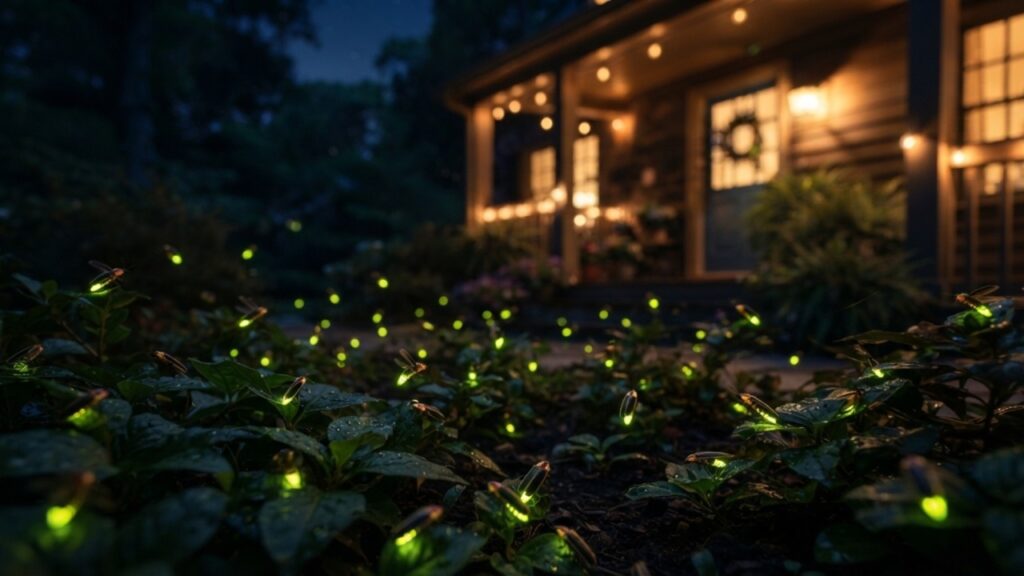
Summer evenings can feel slightly wrong when the lawn is neat, the garden beds are tidy, the porch light works perfectly, and hardly anything is blinking over the grass.
A yard can look polished and still give fireflies very little help. Artificial light is one issue. Habitat loss is another. Closely cut grass, spotless beds, dry soil, and routine pesticide use can also make a property less useful to insects that spend much of their life close to the ground.
We have become very good at lighting our yards ourselves. Unfortunately, that is not especially helpful to an insect trying to communicate with tiny flashes of its own.
No single change guarantees a yard full of fireflies. Still, one of the easiest checks is also one of the cheapest.
Start with the porch light.
What Should be Done with a Porch Light?

Fireflies do not flash because summer evenings needed decoration. Light is part of how many species communicate and find mates.
At least 80% of firefly species in the United States and Canada use flashes or other bioluminescent signals. Males often signal while flying, while females answer lower down in vegetation.
Artificial lighting raises the brightness those signals have to compete with. Research on one studied species found that artificial light reduced female responses, and brighter experimental conditions were also linked with lower mating activity.
During our research, we came across a study in which researchers gave male fireflies a choice between two identical female signals, with one exposed to 5 lux of artificial light. Out of 29 males attracted during the test, 28, or 96.6%, headed for the dark signal.
Fireflies are apparently not impressed by our lighting plan.
Effects can differ by species, so a porch bulb will not create exactly the same response in every firefly.
Your porch light is doing exactly what you bought it to do. Unfortunately, the fireflies would prefer that it take the evening off.
What to Do Tonight
A few simple changes can reduce unnecessary light without making the yard inconvenient to use:
- Turn off the porch light around dusk when nobody needs it.
- Switch off decorative string lights and path lights during firefly activity.
- Check for fixtures that shine directly into grass, shrubs, or low plants.
- Use motion sensors or timers when lighting is needed for safety.
- Shield fixtures and use only as much brightness as the area actually needs.
- Close curtains or blinds when strong indoor light spills across the yard.
We would check these basics before spending money on plants, water features, or major yard changes. Very complicated-looking problems occasionally have embarrassingly simple first steps.
If Turning Off the Light Is Step One, Habitat Is Step Two
Adult fireflies get most of the attention because they are the part we can see. Much of a firefly’s life happens earlier, close to the soil.
Larvae use protected, moist places such as soil, leaf litter, and areas beneath decaying wood. A yard can look carefully maintained to a person while offering very little shelter to a developing firefly.
That changes how we look at ordinary yard cleanup.
A layer of leaves under shrubs may not look important. A damp patch under a tree may look like an area that needs fixing. A piece of decaying wood may look like clutter.
To a firefly larva, those can be useful living conditions.
Stop Cleaning Every Square Foot of the Yard

Removing every leaf, fallen twig, and bit of decaying wood also removes the cool, damp cover their larvae use close to the soil. We are not suggesting that you stop maintaining the property altogether.
A better way is to choose a few tucked-away areas where cleanup becomes a little less enthusiastic.
Leave Some Leaves Where They Can Actually Help
Fall cleanup has a way of becoming competitive. One leaf turns into a pile, the pile turns into several bags, and soon the bed is so bare it looks vacuumed.
Firefly larvae benefit when some leaf litter stays in place. Leaves help keep soil cool, shaded, and damp.
A modest layer is enough to make the idea practical. Firefly conservation guidance suggests letting leaves collect about 2 to 4 inches deep in a shaded corner, beneath a tree, or along a garden edge. No need to build a knee-high leaf bank beside the patio.
Loose leaves can also act as mulch beneath trees or along garden borders. You do not need to leave the entire yard buried.
Pick a spot that already makes sense for it. A garden edge, the base of mature shrubs, or an area under a tree can hold a loose layer of leaves without making the property look neglected.
Decaying logs can help too. If a piece of fallen wood is not creating a safety problem or attracting a pest you need to control, a small amount of it can provide shelter in a quiet part of the yard.
A completely bare garden bed may look impressively tidy. A firefly larva is unlikely to be impressed.
Let One Part of the Lawn Get a Little Less Respectable
Closely mowed turf offers less shelter than taller vegetation. That does not mean giving up mowing entirely.
Choose one area that does not need the same haircut as the front lawn. A back corner, fence line, garden edge, or strip behind a shed can stay taller.
Extra growth helps hold humidity and gives young fireflies more cover near the ground.
We usually prefer this sort of small test before recommending a complete yard redesign.
If one strip of taller growth fits the property and causes no practical problem, keep it. If it blocks access, hides a drainage issue, or becomes difficult to manage, choose another area.
There is a considerable distance between slightly taller grass beside the back fence and neighbors organizing a search party for lost hikers.
Give Them a Damp, Shady Corner
Firefly larvae favor moist conditions, and shade helps soil stay cooler and damp longer.
Many yards already have a suitable area. Look under mature shrubs, along shaded beds, near low spots, or close to places where rainwater naturally soaks into the soil.
We would inspect what already exists before adding anything major.
A sensible order looks like this:
- Find a shaded area that already stays a little damp.
- Keep some leaf litter or organic material there.
- Avoid stripping the area bare during routine cleanup.
- Improve moisture retention with mulch or added plant cover if needed.
- Consider larger changes only when they fit the property.
Installing a pond is not step one.
Sometimes the useful habitat is already sitting under a tree while everyone is busy planning a project.
Plant More Than Lawn

Native wildflowers, grasses, shrubs, ground covers, and trees create more structure. Plants give adults places to perch, help shade the soil, hold moisture, and support small organisms that fit into the firefly food web.
Layered planting can also work without turning the yard into a major construction project.
Homeowners can adjust the scale to fit the property:
| Level of Change | What to Do |
| Minimal change | Make an existing garden bed a little wider and add native perennials or grasses. |
| Moderate change | Replace a strip of lawn along a fence with taller native plants. |
| Larger change | Create a layered planting with ground cover, grasses, shrubs, and trees. |
We would start with the smallest change that solves the habitat problem you actually have.
A yard with decent shade and existing beds may only need a few planting changes. A yard made almost entirely of short grass may benefit more noticeably when one section gains taller, denser plant cover.
Be Careful What You Spray
Firefly larvae spend long periods in or near soil and vegetation. Those are also common treatment zones for lawn pests, garden pests, and mosquitoes.
Broad pesticide use can affect fireflies directly and can also reduce small organisms that larvae eat.
Another study shows us that 70.4% fewer adult fireflies in corn plots planted with clothianidin-treated seed compared with untreated plots. A backyard is not a corn trial, so we would not copy that percentage onto a lawn.
Still, it is a useful reminder to treat the pest you actually have instead of automatically treating every square foot around it.
Mosquitoes can be a real problem. Turf insects can damage grass. Plant pests can wreck a bed that took years to establish.
Avoid routine spraying in taller grass, leaf litter, and garden beds that may hold firefly larvae.
Spraying the whole yard because one corner has a problem is often the yard-care version of replacing a faucet because the washer is worn.
You Do Not Need to Turn the Yard Into a Nature Preserve Overnight

Firefly-friendly changes do not have to arrive as one giant project.
Start with actions that take almost no effort, then work outward.
Tonight, shut off unnecessary outdoor lights.
Over the weekend, choose one corner where the grass can stay taller, and a few leaves can stay put.
During regular yard work, leave a shaded, damp spot less disturbed.
When adding plants, favor native grasses, flowers, shrubs, and layered growth.
When dealing with pests, use the narrowest treatment that solves the actual problem.
A useful pattern appears here. Many firefly-friendly changes involve doing less, not buying more.
Less lighting. Less mowing in selected places. Less cleanup in selected beds. Less broad spraying.
Homeowners are usually told that better yards require more work. Fireflies have entered negotiations with a surprisingly different proposal.
Closing Thoughts
Turning off unnecessary outdoor lighting is the quickest and cheapest place to start, but darkness alone will not provide everything fireflies need.
Useful habitat is slightly less polished than many yards are taught to be. Moist soil, leaf litter, taller vegetation, native plants, shaded areas, and careful pesticide use all help create better conditions.
Nobody needs to let the whole yard go.
Pick a few places where you stop working quite so hard. Fireflies may appreciate your sudden decline in enthusiasm for perfect housekeeping.